

Key Takeaways
- Overthinking is often a protective habit that replays worries and predicts worst-case scenarios; meditation helps interrupt the loop by training you to stop obeying every thought and return to your body, breath, and the present moment.
- There is no single best meditation for everyone—choose the practice that matches what your mind is doing in the moment (e.g., grounding for racing thoughts, soothing for emotional flood, present-focused for future pull).
- Practical techniques: breath awareness for racing thoughts, body scan for mental overload, guided meditation for anxious/stimulated minds, noting for obsessive loops, loving‑kindness for self‑criticism, visualization for future worry, and walking meditation for restlessness.
- Consistency matters more than intensity—small daily practices (five to ten minutes) retrain habitual overthinking more effectively than occasional long sessions.
- The goal of meditation is not to eliminate thoughts but to develop the ability to notice thoughts without being dragged by them, creating space to pause, respond, and build calm and clarity.
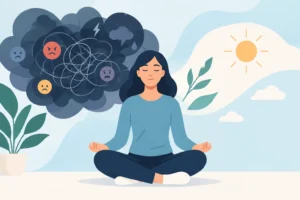
Your mind says it is trying to protect you. It replays the conversation, predicts the worst-case scenario, and searches for the perfect answer that will finally make you feel safe. But overthinking does not create peace. It creates exhaustion. That is why the best meditations for overthinking are not the ones that force your mind to go blank. They are the ones that help you step out of the mental spiral and return to your body, your breath, and the present moment.
If you have ever told yourself, “I just need to think this through one more time,” you already know the trap. The loop feels productive, but it keeps you stuck. Meditation interrupts that pattern. Not because it magically erases every thought, but because it trains you to stop obeying every thought that shows up.
What makes the best meditations for overthinking actually work?
Overthinking usually has a few roots. Sometimes it is anxiety. Sometimes it is perfectionism. Sometimes it is fear of making the wrong move, being judged, or losing control. So the best meditation depends on what your mind is doing in that moment.
If your thoughts are racing, you need something grounding. If you are emotionally flooded, you need something soothing. If your mind keeps pulling you into the future, you need something that brings you back to what is real right now. That is why one style of meditation will not fit every kind of mental overwhelm.
There is also an important truth here. Some meditations can feel frustrating when you are deeply overstimulated. Silent meditation, for example, can be powerful, but for some people it becomes another room where the mind gets louder. That does not mean you are bad at meditating. It means you may need more structure, more guidance, or a more active technique.
1. Breath awareness meditation for racing thoughts
When your mind is moving fast, your breath is often doing the same. Short, shallow breathing tells your nervous system that something is wrong, even when you are physically safe. A simple breath awareness meditation helps reverse that signal.
Sit down, place one hand on your chest and one on your stomach, and breathe in slowly through your nose. Let the exhale be slightly longer than the inhale. Then keep your attention on the feeling of air moving in and out. Not perfectly. Just gently.
This works because it gives the mind one job. Follow the breath. Every time a thought pulls you away, return. That return is the practice. It is not failure. It is the rep that strengthens your focus.
If counting helps, try inhaling for four and exhaling for six. If counting makes you more tense, drop it and just feel the breath. The goal is not control. The goal is steadiness.
2. Body scan meditation for mental overload
Overthinking pulls you into your head. A body scan brings you back into your life.
This style of meditation moves your attention through the body, usually from head to toe or toe to head. You notice tension, warmth, heaviness, pressure, and sensation without trying to fix any of it. That matters because overthinking often feeds on resistance. The more you fight your internal state, the more intense it can feel.
A body scan is especially helpful at night when your thoughts are circling and your body is tired, but your brain refuses to cooperate. It tells your system, “You do not need to solve everything right now. You need to come back to yourself.”
If you tend to live in stress mode, this meditation can feel surprisingly emotional. That is normal. Many people do not realize how much anxiety they are carrying until they pause long enough to feel it. Stay gentle with yourself.
3. Guided meditation for anxious overthinking
If silence feels like a battle, start with a guided meditation. This is often one of the best meditations for overthinking because it gives your attention something steady to follow.
A calm voice can help cut through the internal noise and redirect your focus before the spiral picks up speed. That is not weakness. It is support. And support is often what creates change.
Guided meditations are especially useful when you are new to meditation, emotionally drained, or so mentally busy that self-guiding feels impossible. Some focus on breathing. Others use visualization, affirmations, or grounding cues. The best one is the one you can actually stay with.
This is where a mentor-style approach can make a difference. A supportive voice does more than tell you to relax. It reminds you that you are safe, capable, and not trapped in your current state. That shift is powerful.
4. Noting meditation for obsessive thought loops
Some thoughts do not just pass through. They hook you. You argue with them, analyze them, and chase them around in circles. That is where noting meditation can help.
In this practice, you silently label what is happening in your mind with simple words like “planning,” “worrying,” “remembering,” or “judging.” Then you return to the breath or the body.
This small act creates distance. Instead of becoming the thought, you witness it. Instead of saying, “I am falling apart,” you begin to notice, “My mind is worrying again.” That shift can break the spell.
Noting is not about suppressing thought. It is about removing some of its authority. Your mind can produce a hundred stories in an hour. You do not need to follow all of them.
5. Loving-kindness meditation for self-critical thinking
A lot of overthinking is not just mental noise. It is self-attack.
You replay what you said. You question what people think of you. You punish yourself for not handling life better. In those moments, the answer is not always more focus. Sometimes the answer is more compassion.
Loving-kindness meditation invites you to repeat phrases such as, “May I be safe. May I be calm. May I be free from suffering.” It may feel awkward at first, especially if you are used to motivating yourself through pressure. But that discomfort often reveals how harsh your inner world has become.
This kind of meditation can soften the emotional fuel behind overthinking. When your mind no longer feels like an enemy, it becomes easier to let thoughts pass without turning them into identity.
6. Visualization meditation for future-based worry
Overthinking often lives in the future. What if this goes wrong? What if I fail? What if I lose everything I worked for?
Visualization meditation can help when used the right way. Not as fantasy or escape, but as nervous system training. You picture yourself grounded, steady, and capable in the middle of uncertainty. You imagine responding with calm instead of panic.
This matters because your brain responds to imagined scenarios. Most overthinkers already use visualization, but in the wrong direction. They rehearse disaster. Meditation helps you rehearse trust instead.
Keep it simple. Picture yourself taking one next step with confidence. Picture your shoulders relaxed. Picture your breath steady. The goal is not to deny challenges. The goal is to stop practicing fear all day long.
7. Walking meditation when sitting still feels impossible
Sometimes the best thing you can do is stop trying to force stillness.
Walking meditation is ideal for restless minds, high stress days, or moments when sitting quietly makes you feel more trapped than calm. As you walk slowly, pay attention to the feeling of your feet touching the ground, the rhythm of your steps, and the movement of your breath.
This gives your thoughts less room to run wild while still training presence. It is meditation for people who need motion. And that is valid.
If you are overwhelmed, go outside if you can. Let the air hit your skin. Feel the ground under you. Let your body remind your mind that this moment is survivable.
How to choose the right meditation for your kind of overthinking
The right practice depends on the moment. If you are spiraling fast, choose breath awareness or a guided meditation. If you are mentally drained and disconnected, try a body scan. If your thoughts are repetitive and sticky, use noting. If your inner voice is brutal, choose loving-kindness. If you are restless, walk.
The mistake many people make is trying one meditation once, then deciding it does not work. Real change comes from repetition. Your mind learned overthinking through repetition too. You are not broken. You are trained. And what has been trained can be retrained.
That is why consistency matters more than intensity. Five to ten minutes every day will do more for your peace than one long session after a breakdown. Small shifts, practiced often, become a new mental baseline.
If you want extra support, using structured audio guidance from a brand like Total Mindshift can make it easier to stay consistent, especially when motivation is low and your mind keeps pulling you back into old patterns.
A better goal than “stop thinking”
You do not need to become a person with zero thoughts. That is not the win. The win is becoming someone who can notice a thought without getting dragged by it. Someone who can pause before reacting. Someone who knows how to come home to themselves when the mind starts making noise.
Overthinking can make you feel powerless, but you are not powerless. You can train calm. You can build clarity. You can create space between you and the mental habits that have been draining your energy for too long.
Start with one meditation. Keep it simple. Show up again tomorrow. Peace is not something reserved for other people. It is something you can practice your way back to.
Latest Post

7 Habits Supporting Lasting Behavior Change
October 19, 2026
No Comments

Online Coaching Reviews: What Real Change Looks Like
October 17, 2026
No Comments

Best Self Improvement Audio Programs for Change
October 15, 2026
No Comments