

Key Takeaways
- Negative spirals are chain reactions and learned mental loops—not proof that you are broken—where a trigger sparks a story, that story creates emotion, emotion changes behavior, and behavior fuels the story.
- Interrupt the spiral by calming your nervous system first: ground your body (both feet on the floor, relax jaw/shoulders), take slow breaths, and name the experience (e.g., “This is a spiral”) to create distance.
- Cut the momentum with state-shifting actions: change rooms, step outside, splash water on your face, put your phone down, drink or eat something, walk, or do a short grounding task rather than rumination.
- When intensity drops, challenge absolutist negative thoughts with balanced, honest replies (not fake positivity)—separate moments from identity (e.g., “I had a hard moment, but it is not my whole life”).
- Prevent future spirals by noticing personal warning signs, building short reset routines (breathwork, journaling, movement, check-ins), addressing root causes (sleep, boundaries, habits), and getting professional help if spirals are intense or frequent.
You were fine ten minutes ago. Then one comment, one mistake, one ignored text, or one stressful thought sent your mind racing. Suddenly everything feels heavier. Your confidence drops, your body tightens, and your brain starts feeding you one dark thought after another. If you are searching for how to stop negative spirals, start here: you do not need to solve your whole life in one moment. You need to interrupt the pattern before it pulls you deeper.
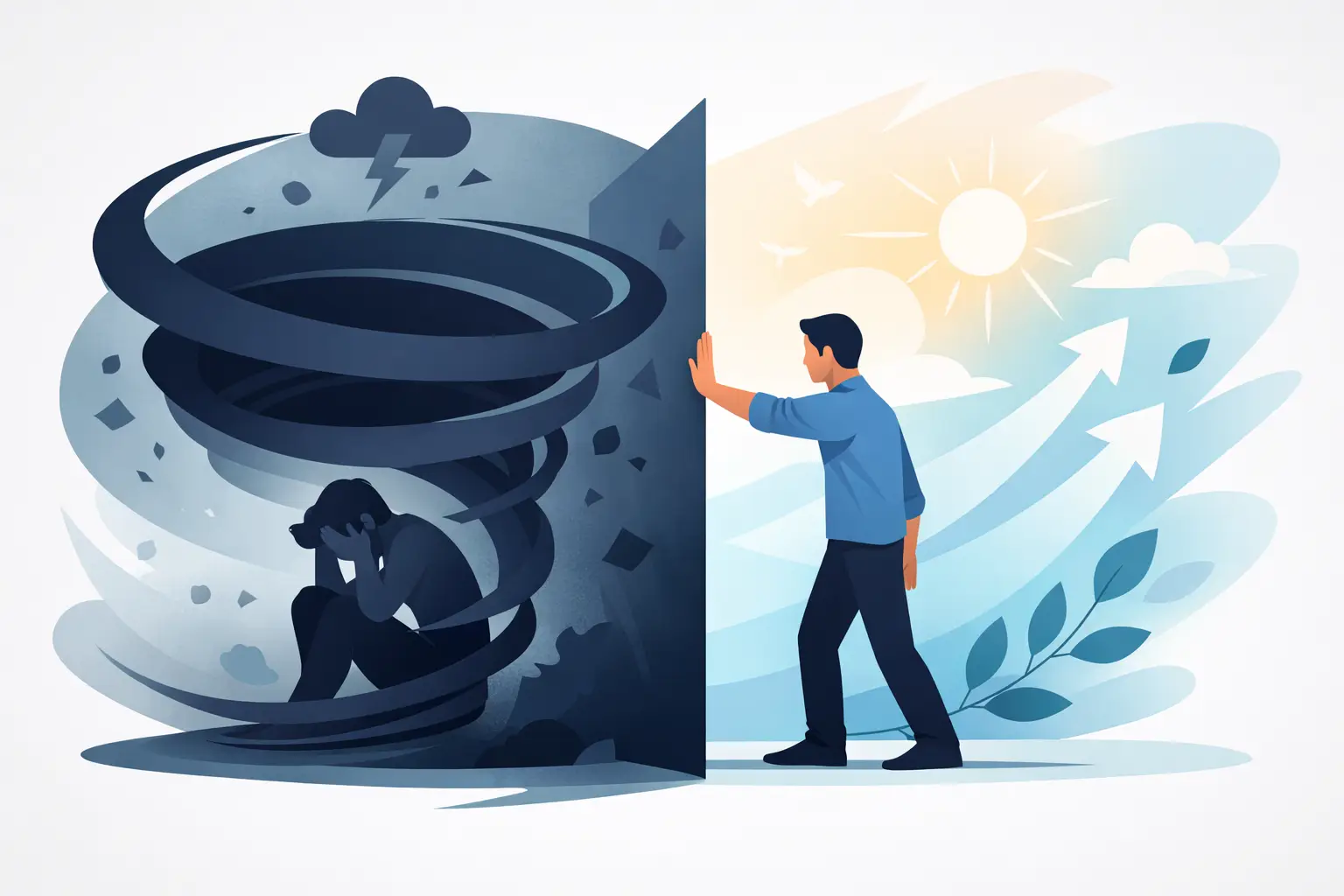
That matters, because a negative spiral is rarely about one thought. It is a chain reaction. A small trigger sparks a painful story, the story creates emotion, the emotion changes your behavior, and that behavior gives the story more fuel. You withdraw, overthink, snap at someone, numb out, or assume the worst. Then you feel worse about doing that, and the spiral keeps turning.
The good news is that spirals are not proof that you are broken. They are learned mental loops. And learned loops can be interrupted, softened, and replaced.
Why negative spirals feel so powerful
When you are in one, your mind acts like it is protecting you. It scans for danger, predicts more pain, and tries to gain control by overanalyzing everything. But instead of creating safety, it creates exhaustion.
This is why telling yourself to just think positive usually does not work. Your nervous system is already activated. Your body believes something is wrong. Trying to paste a cheerful thought over panic, shame, or hopelessness often makes you feel even more frustrated.
Real change starts when you stop fighting your state and start shifting it. First calm the system. Then challenge the story. Then choose a better direction.
How to stop negative spirals in the moment
If your thoughts are speeding up, your first goal is not clarity. It is interruption.
Start with your body. Put both feet on the floor. Relax your jaw. Drop your shoulders. Take one slow breath in through your nose and a longer breath out through your mouth. Then do it again. This is simple, but it sends a message to your system that you are here, now, and not trapped in the thought.
Next, name what is happening without drama. Say to yourself, This is a spiral. That one sentence creates distance. You are no longer fully inside the storm. You are observing it.
Then get specific. Ask, What triggered the negative spirals? Keep it factual. Maybe it was a hard conversation. Maybe you felt rejected. Maybe you are tired, hungry, overstimulated, or disappointed. The trigger matters because spirals grow when everything feels vague and overwhelming.
After that, cut the momentum. Stand up and change rooms. Splash cold water on your face. Step outside. Put your phone down for ten minutes. Do not keep feeding the spiral with more scrolling, more checking, more rumination. A state shift can break a thought loop faster than another hour of analysis.

The thought is not always the truth
Once the intensity drops, you can work with the thought itself.
Negative spirals tend to speak in absolutes. I always mess things up. Nothing ever changes. They do not care about accuracy. They care about emotional momentum.
So challenge the thought with strength and honesty. Not with fake positivity, but with balance. If your mind says, I ruined everything, answer with, I had a hard moment, but one moment is not my whole life. If it says, I am failing again, answer with, I am struggling right now, and struggling is not the same as being defeated.
This shift sounds small, but it is powerful. You are training your mind to stop turning pain into identity.
That is where many people get trapped. They do not just think, I made a mistake. They think, This proves who I am. That belief drains energy fast. It creates shame, and shame is one of the strongest fuels for negative spirals.
What to do instead of feeding the spiral
A spiral wants your full attention. It wants isolation, doom-scrolling, self-judgment, and mental replay. You do not beat it by arguing forever. You beat it by refusing to keep giving it material.
Do one stabilizing action. Drink water. Eat something nourishing. Go for a ten-minute walk. Send one honest text to someone safe. Clean one small space. Journal for five minutes. Put on a guided meditation. These actions are not random. They signal self-respect.
Momentum works both ways. A downward spiral gets stronger with repeated negative choices. An upward shift begins with repeated grounding choices. Not glamorous choices. Not perfect choices. Just grounded ones.
This is where people often go wrong. They wait to feel better before taking care of themselves. In reality, taking care of yourself is often what helps you feel better.
How to stop negative spirals before they start
The best way to handle a spiral is to catch it early.
Most spirals have patterns. They show up when you are sleep-deprived, emotionally neglected, overcommitted, lonely, hungover, burned out, or avoiding something important. They also show up when old wounds get touched. Rejection, criticism, uncertainty, and comparison can all press on sensitive places.
Start noticing your personal warning signs. Maybe your inner voice gets harsher. Maybe you become obsessive. Maybe you start assuming people are against you. Maybe your body feels wired and heavy at the same time. Those are signals, not personal failures.
When you know your pattern, you can interrupt it earlier. You can build a short reset routine before the spiral becomes a full collapse. That might be ten minutes of silence in the morning, daily audio support, breathwork, movement, journaling, or a simple check-in that asks, What am I feeling, what do I need, and what story am I telling myself right now?
That kind of structure is not weakness. It is emotional leadership.
You may need a different response depending on the cause
Not every spiral comes from the same place.
Some are driven by stress and overstimulation. In that case, rest, quiet, and less input may help most. Some are driven by unresolved pain. In that case, the spiral may keep repeating until you process what is underneath it. Some are driven by habits that keep your mind unstable, like constant comparison, poor sleep, substance use, or staying in relationships that drain your nervous system.
This is why self-awareness matters. If you only treat the surface, the pattern returns. If you understand the root, change becomes more lasting.
And yes, sometimes you need support. If your spirals are intense, frequent, or tied to depression, trauma, anxiety, or self-harm thoughts, reaching out for professional help is a strong move. You are not meant to carry everything alone.
The deeper shift that changes everything
At the core of most negative spirals is one painful belief: If I feel bad, something is wrong with me.
That belief creates panic around normal human emotion. Then every hard feeling becomes a threat, and every threat becomes a story.
But emotions are not enemies. They are signals. Sadness may be asking for care. Anger may be pointing to a boundary. Fear may be asking for steadiness, not surrender. When you stop treating every difficult feeling like a disaster, you stop giving it the power to define your day.
This is the real work of mindset change. Not pretending life is easy. Not forcing yourself to be upbeat every second. It is learning how to stay with yourself when your mind gets loud. It is choosing truth over panic, action over paralysis, and self-respect over self-attack.
That is how transformation happens. One interrupted pattern at a time.
If you want a simple phrase to hold onto when the spiral begins, use this: I do not have to follow every thought I feel. That sentence puts you back in the driver’s seat.
You can feel the pull of old patterns and still choose differently. You can have a hard moment and still protect your peace. You can train your mind to stop turning every trigger into a tailspin. That is not wishful thinking. That is practice. And with practice, your inner world can become a safer place to live.
If you are ready for that kind of shift, Total Mindshift exists for exactly this reason – to help you rebuild from the inside out, one daily choice at a time.
The next time your mind starts running downhill, do not ask how to fix your whole life before noon. Just interrupt the next thought, steady the next breath, and choose the next right step.
If you want assistance with this article, please Contact Us